

 Български
 Español
Photography literally means “light writing”, or “painting with light”. The etymology is related to the Greek word “φωτογράφηση” = lightwriting.
Science defines photography as a method of obtaining a permanent image by projecting the image of an object or any object, using a focusing optical system – a photographic lens, onto a photographic medium, which can be a plate, a film with a light-sensitive emulsion or a matrix.
The birthday of photography is considered to be January 7, 1839, when the French scientist François Dominique Arago made an official scientific announcement to the Paris Academy of Sciences about the method discovered by the artist Daguerre for preserving a permanent photographic image. The method received his name – daguerreotype. However, the history of photography can be traced back to the time of Aristotle (384 – 322 BC). For the first time, he observed the phenomenon known as the camera obscura – in Latin, “dark room”.
Camera obscura
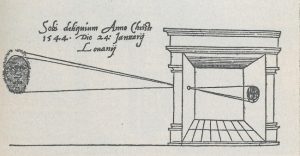
Camera obsura
This is a simplified optical device that allows you to obtain optical images of real objects. It is a dark box into which no light penetrates. The box has an opening on one of the walls and a screen – frosted glass or white paper, on the opposite side. The diameter of the opening is about 0.5 – 5 mm. From the opening to the “screen” a slightly blurred, enlarged and inverted image is obtained. It is on this principle that some of the first cameras work. Repeatedly described by various scientists, such as Abu Ali Alhazen (965 – 1039), Albertus Magnus (1193 – 1280), Roger Bacon (1214 – 1294) and Leonardo da Vinci (1452 – 1519), but at the same time – forbidden by religion and sinking into oblivion again, the camera obscura was last rediscovered by Giovanni Battista de la Porta in 1558.
The father of the photographic lens
In 1568, Danielo Barbaro proposed placing a collecting lens in the camera aperture, which would make it wider and the image projected by the lens much brighter and clearer! This was actually the first photographic lens.
The astronomer Johannes Kepler (1571 – 1630) proposed painting the inner walls of the camera matte black so that they would not diffusely reflect light – a condition that modern camera manufacturers also comply with.
In 1613, the German astronomer Christoph Scheiner (1575 – 1650) constructed, based on Kepler’s idea, a small portable camera with a lens, with which he determined the period of the Sun’s rotation and the inclination of its axis to the ecliptic by observations of sunspots..
In 1759, Lambert laid the foundations of perspective and projective geometry.
In 1857 Caspar Schott constructed the first camera with the ability to focus the image. It consisted of two wooden boxes (chests) that fit tightly into each other. On the bottom of one box was the opening with the lens, and the transparent bottom of the other served as a focal plane – a frame window. Focusing was done by sliding the two boxes into each other.
With a similar camera, Louis Daguerre made his first attempts to obtain a permanent photographic image.
The first improved photographic lens is considered to be the one constructed by Wollaston (1766 – 1826). It consisted of a meniscus collecting lens and a diaphragm. This lens outlined the edges of the frame better than the previously used non-diaphragmatic double-convex lenses.
The evolution in photo-optics production as a reason for fast growth in photography
Photo-optics then developed from the discoveries of Professor Joseph Petzval, who in 1841 constructed a photo lens that was well corrected for optical aberrations. Its aperture was impressive for that time with its dimensions of 1:3:2.
In 1853, Levi proposed the idea of replacing the lens cap, by opening and closing which the exposure was made, with a falling plate – the prototype of the modern photographic shutter.
In 1865, Scheinheil constructed the periscope, and later – the applanate – symmetrical photo lenses with well-corrected distortion.
In 1877, the Pole Władysław Wernerke proposed the construction of a camera working with roll film wound in roll cassettes.
In 1888, the American company Kodak of George Eastman launched a camera with a paper light-sensitive strip, and in 1889 – with a celluloid strip.
In 1913 The first Mentor SLR camera was produced.
In 1924, the first 6 Leica cameras of the Leitz company, designed by Oskar Bernhard (1879–1936), were released on the market. The frame format of these cameras was 24×36 mm, on a 35 mm wide, 165 cm long film, allowing the shooting of 36 frames. Since then, this small format has been popularly called the “Laika format” and is the most common today.
In 1929, the first two-lens camera, the Rolleiflex, was produced, also medium format.
In 1934, the Primaflex was produced, with a frame format of 6×6 cm (medium format).
In 1936, the first small-format SLR camera, the Kine-Exacta, was produced in Dresden.
In 1939, the first microformat camera, the Minox, with a frame format of 8x11mm, appeared.
The evolution of photography continues to go hand in hand with scientific discoveries in various fields – optics, fine mechanics, chemistry, electronics. Modern photography finds wide application in all areas of life in science, art, medicine, media and so on.
This area is developing especially quickly and is becoming more accessible to more people nowadays, when digital photography and large social networks on the Internet are a fact, which provide an opportunity for a huge audience of photographic images.